One Saturday Sister Limburg and I took a nice long
walk around our neighborhood. We didn’t get a whole lot of heart-pounding exercise because we stopped too much along
the way to take these pictures of beautiful flowers and other sights along the way. Come walk with me. . . .
Vibrant Poinsettias growing in someone's front yard
It is hard to meet people when they live behind a gate.
This is a very nice home in Samabula and their Bougainvillea are abundant.
We have never seen this variety of red flower open--perhaps they are shy.
Dainty and sweet little purple flowers--sorry I don't have the correct name for you.
The red flowers appear even brighter against its vivid green foliage. See what a lot of rain will do.
These lavender blossoms are very delicate and pretty.
These palm fronds are being taken over by morning glory. A smaller white variety is a pest in Arizona.
Bougainvillea

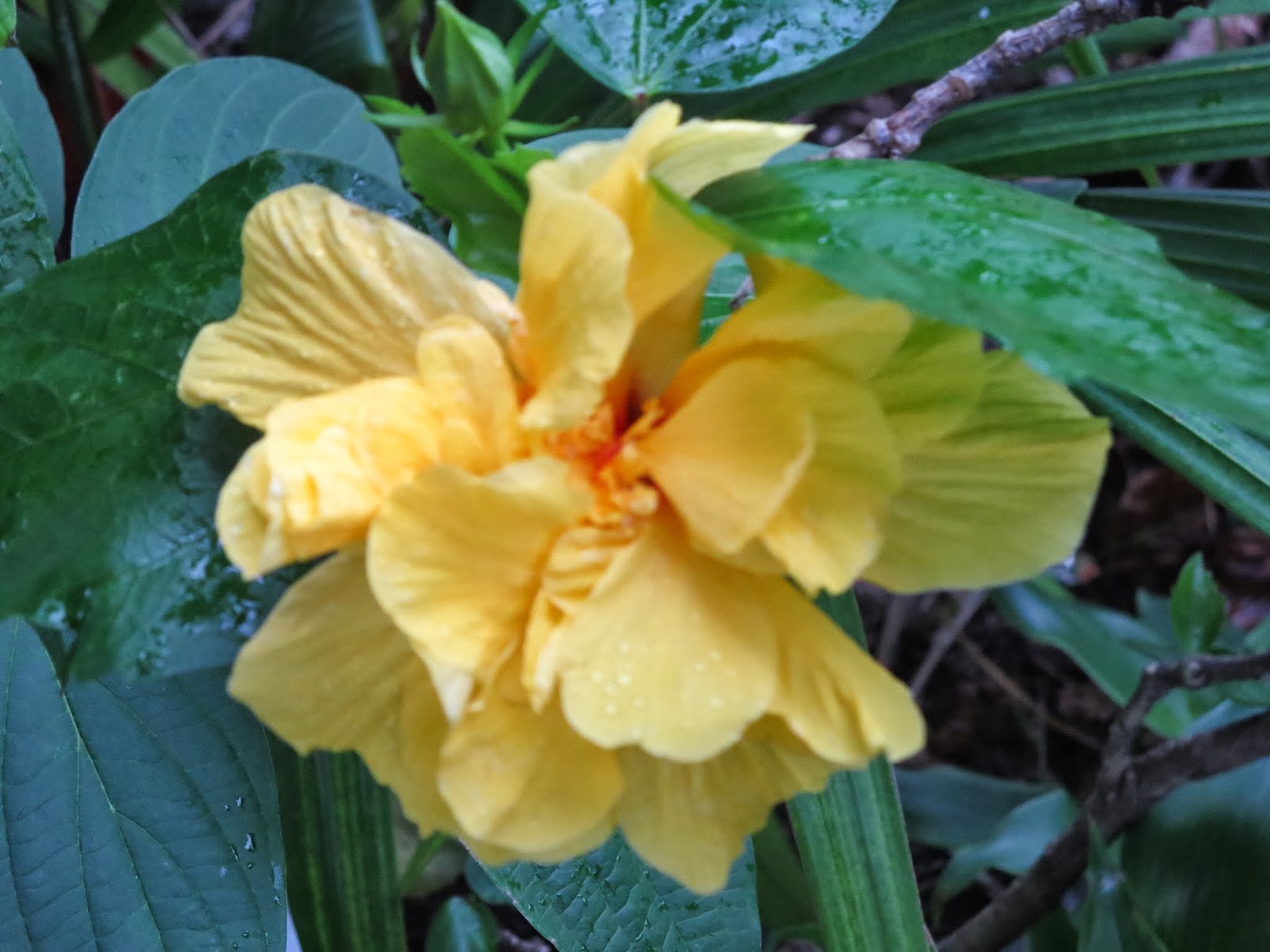
Hibiscus grows everywhere. No frost here to threaten its existence. They like to bloom at the extremities of the bush--so don't prune them too much or you will just have a pretty green bush.

The orange spots are fun.
Perhaps this is a Tiger Lily.

Red Canna Lilly with blue and pink Hydrangeas. My Hydrangeas in Snowflake never got to look like this.

A young teen girl grows and sells these flowers. They appear to be succulents which is surprising in such a wet climate. The tall one in the vase they call Bird of Paradise--nothing like the variety that grows in the desert of Arizona.
A beautifully landscaped front yard. The woman beamed when we complimented her on it.
These purple flowers with the dark stems are just like some in my front yard in Mesa.
It is amazing to me that the desert and wet Fiji can grow the same plants.
I call this "Papaya on Plate"
The little black seeds are very moist and squishy, like I imagine caviar might look. We used to laboriously peel the papaya, but now we eat it halved, seeded, and in the skin--like a cantaloupe half. We enjoy papaya several times a week--a great substitute for those fresh Utah peaches, but not as tangy. Outside our house we can see a banana, mango, papaya, and
coconut trees. All but the mango grow year around. Delicious!
I helped my granddaughter Brooke Bair with her Flat Stanley project at school. Our neighbor Vineel is holding him up with a papaya tree in the background. Notice the large green papaya at the top near the trunks all in a cluster. That is the side of our house in the background.
Vineel is 20 and studying air conditioning at the local university. He is holding Flat Stanley (who travels all over the world in an envelope) by their banana tree. Those leaves are six feet long and are rolled very tightly in a long spear when they first appear. Within a week they unroll themselves.
Here are a lovely bunch of coconuts. They also grow in a cluster next to the trunk. You don't want one of those falling on your head! They are heavy--6 pounds! Sister Limburg's grandson told her that more people die from coconuts falling on their heads than from sharks. Do you believe that? He is afraid for his grandma.
A healthy coconut palm will produce 50 coconuts annually. Each coconut takes a year to fully mature. Every
coconut is made up of a smooth outer rind, a thick husk, and a hard
inner shell pitted with three germination pores, a layer of dense white
meat and a center with liquid "coconut milk." The trees start bearing coconuts by the time they are seven or eight
years old. Coconut palms may reach heights of 50 to 80 feet with a life
span of 80 years.The white portion of the coconut can be eaten and it also contains
coconut oil, for which there are numerous uses including soap products. (It is good for dementia too.)
The hairy husk can be made into rope or twine or serve as fuel for
cooking. The coconut shell may serve as a bowl or cup. Fronds from
coconut palm trees often are woven into baskets, belts, brooms, chairs
and fans. Trees that no longer produce coconuts can be cut down,
creating wood for furniture. You did want a mini-education on coconuts, didn't you?

These coconut vendors posed with Flat Stanley for the price of a coconut--$2 FJD or $1.14 USD.
Angel Moroni on top of the Fiji Temple peaks through the front deck of a home on the next street. The Suva government asked the church to keep him brightly lit at night to act as a lighthouse to guide the ships in through the reefs. He is a cheerful beacon to us as well--especially when we get lost and disoriented at night.
This is a drainage area/park. Notice the humor on the sign. They use weed eaters to cut the grass.
On our walk we saw these youth who were attending a four-day youth conference with our Church. They were doing service projects on this last day of the conference. Over 600 youth attended and they came from all the islands of Fiji.
The leaders are in blue and the youth in yellow shirts.
A view of the bay
along our walk--the same bay that the Angel Moroni looks out on.
Another bay view with
a very pink wall in the foreground.
The United States
Embassy and “Old Glory” are just one block from the Mission Office and Temple. I love to see our flag flying.
This is a type of citrus.
Lemons here are green and bumpy.
They import yellow lemons and oranges. I have not seen any grapefruit.
He is cutting off growth on
a retaining wall with a machete.
I like it better green.
Drainage ditches are
common along roads and sidewalks. Note the thick moss.
Driveways often drop off to a ditch on both sides. Ditches make cautious drivers.
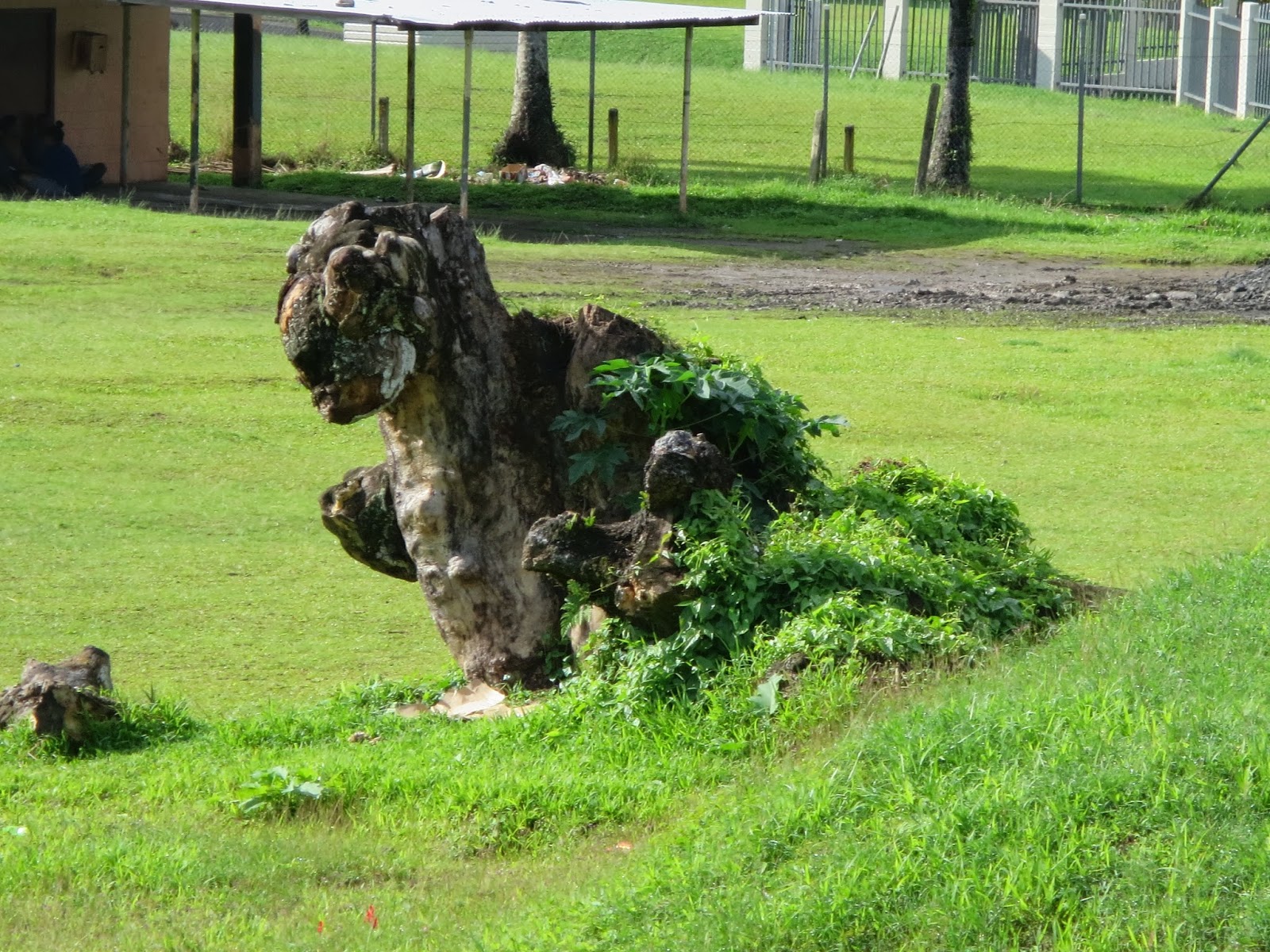
This tree stump looks
like a lion. It “guards” the rugby field.
The men play even in the rain and the
mud. Fijians love Rugby!
A cute little private
kindergarten near our home.
We see this sweet grandpa walking his granddaughter to "Kindagarten" on our way to work.
We passed three playgrounds on our walk. Children are important here.
I thought this was kind of an interesting tree. Sister Limburg is in the foreground.
We are about at the end of our walk.
Our neighbor has a
wonderful vegetable garden in his front yard.
Those are Marigolds growing in front of the fence.
Clothes are hanging in the front yard because the back yard slopes down a steep hill.
The “Shopping Centre”
on our street. Actually there are nice big grocery stores here and even a CostULess similar to Costco where we can buy American food and products.
Kava is an addictive
narcotic drink and very much part of the Fijian culture.
Church leaders have counseled against
it.
This shop is across the street from our house and down a short ways.
Well that ends our walk around our neighborhood.
I think we really did see some amazing things all on a Saturday morning.
I love it here in Fiji and I love being on a mission.